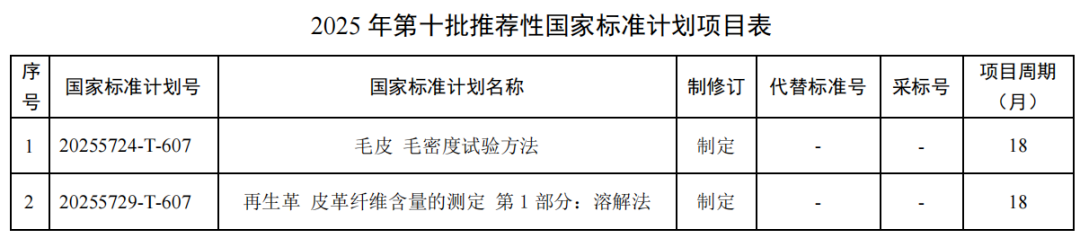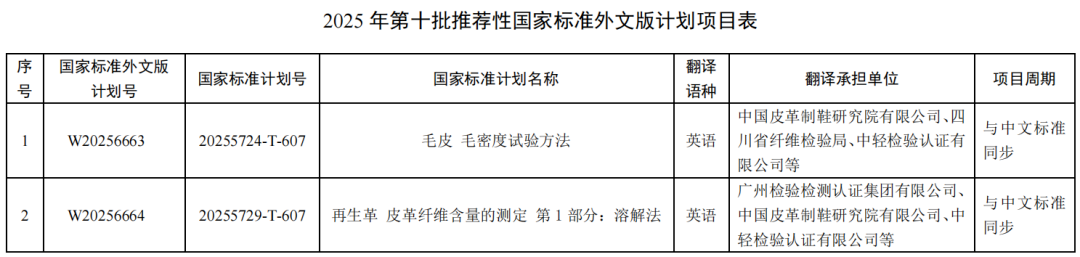
Recently, the Standardization Administration of China (SAC) issued a notice (SAC Document No. 58 [2025]) regarding the tenth batch of recommended national standards and related foreign language versions for 2025. Two national standards, "Regenerated Leather - Determination of Leather Fiber Content - Part 1: Dissolution Method" and "Fur - Test Method for Hair Density," both under the jurisdiction of the National Technical Committee on Standardization of Leather Industry (hereinafter referred to as "Leather Standardization Committee"), and their corresponding foreign language versions were officially approved.
These two approved standards precisely focus on key technological nodes in the industry's development. The approval of "Regenerated Leather - Determination of Leather Fiber Content - Part 1: Dissolution Method" is of significant breakthrough importance. It is understood that my country's leather tanning and leather products industry generates a large amount of leather scraps annually. Regenerated leather, as an important direction for the resource utilization of scraps, directly determines product quality due to its leather fiber content. However, previously, there were no dedicated testing methods for this indicator both domestically and internationally, and existing methods for determining protein content are easily affected by additives, leading to inaccurate results. This standard will establish a scientific solvent extraction testing system, providing precise data for the quality assessment of recycled leather and promoting the standardized development of leather waste resource utilization.
The standard "Test Method for Fur Density" establishes testing specifications for core quality indicators of fur products. As a key parameter for measuring the warmth, durability, and aesthetics of fur, a unified testing method can eliminate differences in results under different testing scenarios, providing a unified technical benchmark for quality judgment in fur production and trade, and further standardizing market order.
It is noteworthy that both standards have been approved for international language versions simultaneously, which aligns closely with the international standing of my country's leather industry. As a major global producer, exporter, and consumer of leather, the development of international language versions of these standards will help align my country's technical specifications with international standards, reduce technical barriers in international trade, and enhance the international compliance competitiveness of my country's leather products.
According to a relevant official from the Leather Standardization Technical Committee (LSTC), the LSTC Secretariat will strictly follow standardized work processes, coordinating the drafting, consultation, and technical review of the standards and their international language versions. By strengthening coordination across the industry chain and widely incorporating industry feedback, we ensure that the standards are technically advanced, scientifically sound, and practically feasible, thus completing the drafting task on schedule. To gather industry wisdom, the Leather Standardization Technical Committee (LSTC) also extends an invitation to the entire industry, welcoming relevant organizations to actively participate in the standard drafting work. Those interested can contact the LSTC Secretariat.
The initiation of these two standards and the proposed foreign language version is an important step in improving my country's leather industry standardization system. After implementation, the standards will further fill the testing technology gaps in the fields of recycled leather and fur, providing technical support for the high-quality development of the industry. Simultaneously, the promotion of the foreign language version will help Chinese leather standards "go global," enhancing the industry's international influence.