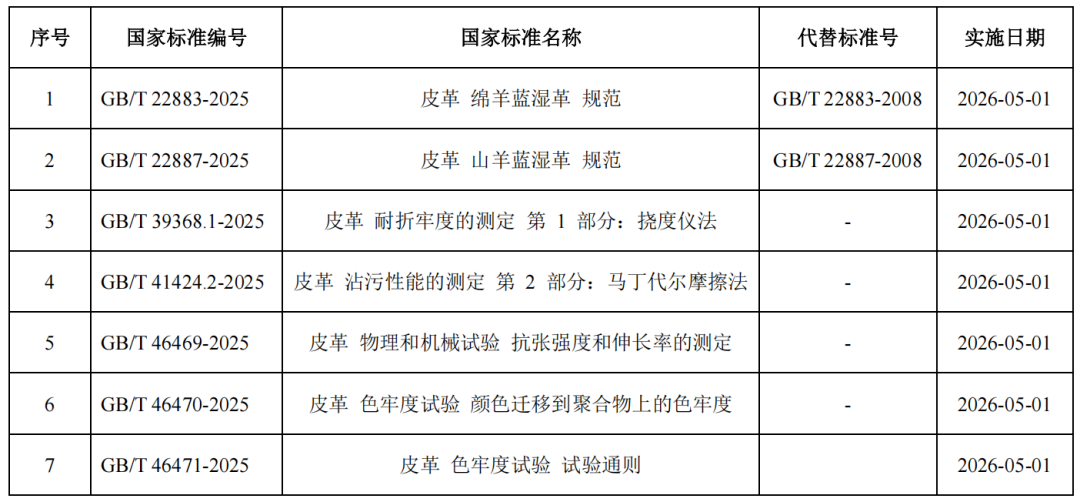
The State Administration for Market Regulation (National Standardization Administration) announced on November 10th the official approval and release of seven national standards for the leather industry. These standards cover three core dimensions: raw material quality, physical properties, and color fastness testing, laying a solid foundation for the high-quality development of the leather industry through comprehensive technical specifications across the entire supply chain. These standards will officially take effect on May 1, 2026, with two raw material standards completely replacing the 2008 versions, achieving iterative upgrades in technical requirements.
Among the standards released this time, the two raw material quality standards, "Leather - Sheep Wet Blue Leather Specification" (GB/T 22883—2025) and "Leather - Goat Wet Blue Leather Specification" (GB/T 22887—2025), have attracted significant attention from the industry. According to a relevant official from the National Technical Committee for Standardization of the Leather Industry, the new standard clarifies for the first time the grade requirements for raw materials of sheep and goat wet blue leather, sets quantitative standards for key indicators such as sensory quality and shrinkage temperature, and strictly limits the thresholds for heavy metals and harmful chemicals, while also providing unified testing methods. This addresses the issue of inconsistent raw leather quality at the source, ensuring the compatibility of raw materials for downstream leather goods, footwear, and automotive interior industries.
Three new standards in the field of physical performance testing establish a scientific quality evaluation system. "Leather - Determination of flexural strength - Part 1: Deflectometer method" accurately assesses durability by simulating everyday bending scenarios; "Leather - Physical and mechanical tests - Determination of tensile strength and elongation" provides quantitative data on the tear resistance of products; and "Leather - Determination of staining properties - Part 2: Martindale friction method" fills the standardization gap in stain resistance testing. Industry insiders indicate that unified testing methods will eliminate data barriers between companies, helping them to optimize tanning and finishing processes, and are expected to increase the industry's average product qualification rate by 3-5 percentage points.
The new standards for colorfastness testing precisely address consumer concerns. The "General Rules for Colorfastness Testing of Leather" establishes a unified testing environment and operating procedures, significantly improving the comparability of results from different testing institutions. The "Colorfastness Testing of Leather: Color Migration to Polymers" standard addresses common scenarios where leather products are used with polymer accessories, establishing a method for assessing color migration risks. This will effectively solve the problems of fading and color bleeding in leather bags, shoes, and other products over long-term use, improving the consumer experience.
As the world's largest producer, exporter, and consumer of leather, my country's leather industry had an annual output value exceeding one trillion yuan in 2024. Previously, some sectors suffered from outdated standards and inconsistent testing methods. The release of these standards will complement the genuine leather certification system, building an industrial development pattern of "standardized production, evidence-based testing, and guaranteed quality." Enterprises have already begun adjusting their production lines to adapt to the new standards, with many stating that they will help their products better connect with the international market and are expected to increase export orders.
A relevant official from the Standards and Technology Department of the State Administration for Market Regulation emphasized that the implementation of these standards will promote the transformation of the leather industry from "scale expansion" to "quality improvement." By guiding enterprises to increase R&D investment and reduce vicious competition through technical specifications, the standards will also enhance the compliance competitiveness of my country's leather products in the international market, providing solid support for the high-end and green development of the industry.